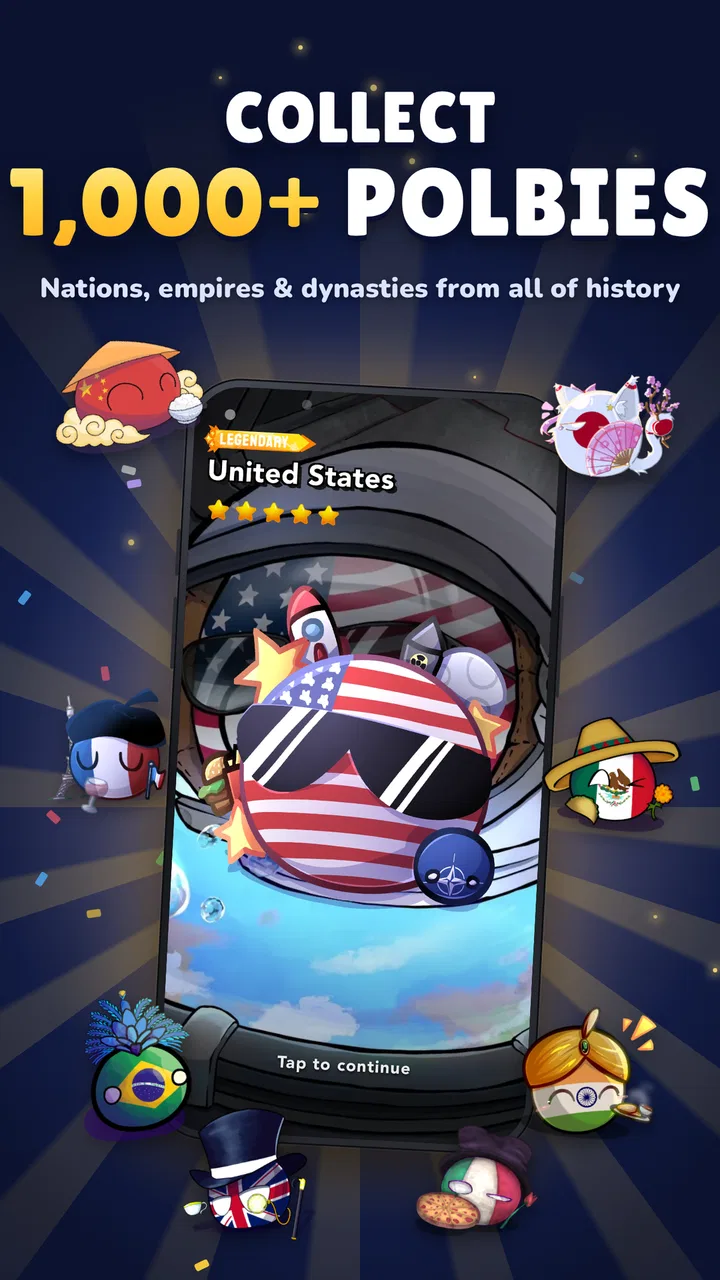
Polandball Go
- 4.8
- Rating
- 50.00K
- Installs
- Free
- Price

 Analysis by App-foxy
Polandball Go is the kind of adventure game that makes a strong first impression by turning nations, alliances, and city exploration into a playful strategy loop. I found the idea immediately approachable: instead of presenting a heavy historical simulation, it gives the world a lighter personality and asks me to build momentum through decisions, upgrades, and discovery. That combination makes it easy to try in short sessions, while still offering enough direction for players who enjoy gradually improving a growing collection of territories or objectives.
The important question, though, is not whether the concept is charming for an afternoon. It is whether the game remains worth opening after the novelty of its visual theme has settled. My experience is that its lasting appeal depends on how much I enjoy repeating a steady cycle of checking progress, choosing what to improve, and exploring again. If that rhythm matches the way you like to play mobile adventures, Polandball Go can become a pleasant everyday game rather than a one-session curiosity.
Why the first week feels inviting
The opening appeal comes from the contrast between a familiar map-based idea and the unusual Polandball presentation. The game is published by Zone Gaming LLC and sits in the adventure category, but it also borrows the satisfaction of light management games. I am not simply moving through a story from beginning to end. I am encouraged to think about alliances, strengthen nations, and make exploration feel connected to progress.
You May Also Like

 AccuWeather: Weather Radar
AccuWeather Review: A Quick, Clear Forecast for Everyday Decisions
For everyday plans, the best forecast is the one you can understand quickly. AccuWeather makes rain timing, radar, and local conditions easy to act on, with a few trade-offs.

 Hill Climb Racing
Why Hill Climb Racing Still Turns Crashes Into One More Run
A tiny car, a bumpy hill and one more upgrade: Hill Climb Racing keeps resurfacing because its simple chaos makes every near-miss feel personal.

 AliExpress - Shopping App
AliExpress Makes Global Shopping Feel Personal, but Shoppers Bear the Risk
AliExpress turns a global marketplace into a pocket-sized discovery engine. Its reach is useful, its shopping loop compelling, and its trade-offs easy to miss.

 Lords Mobile: Kingdom Wars
Lords Mobile Is a Kingdom-Building Routine, Not a Quick Match
A case-by-case verdict on the building, battles, device demands, and social commitments that make Lords Mobile rewarding for some players and exhausting for others.

 PDF Scanner app - TapScanner
TapScanner Makes Paperwork Easier to Capture, Check, and Share
TapScanner makes scanning with a phone feel less like a rescue operation and more like a dependable step in getting work done. Its capture tools are useful, though not flawless.

 Block Blast!
 Shows How Much a Puzzle Game Can Leave Out
A quiet grid game shows why puzzle players increasingly value instant clarity, repeatable skill and low-pressure play—and where the genre still needs to catch up.
More From Our News Desk
View All News


That structure works well during the first few days because every return visit has an obvious purpose. I can look for the next place to explore, consider which improvement deserves attention, and decide whether building relationships with other nations is more useful than pushing ahead immediately. Even without treating the game as a serious strategy exercise, those small choices give the experience more shape than a basic collection of disconnected mini-games.
The free entry point is another reason it is easy to recommend as a trial. Polandball Go is free to download, carries an Everyone age rating, and supports devices running Android 7.0 or newer. That makes it suitable for families and for players using older compatible phones, although the age rating should not be mistaken for a promise that every player will enjoy the same level of strategic pressure or repetition.
During a typical first-week routine, I would open it while waiting for transport, after finishing a task, or during a short break at home. Those moments suit the game better than a long uninterrupted sitting. The concept gives me enough to do without demanding that I remember a complicated plot, and the city-exploration angle creates a feeling of movement even when I only have a few minutes available.
What makes the early loop work
The most useful way to approach the opening is to resist upgrading everything as soon as it becomes available. I get more value by first identifying what kind of player I am in the game. If I enjoy exploring, I should prioritize choices that keep discovery feeling active. If I prefer building an efficient alliance, I should watch how each improvement supports that direction instead of spreading attention across every option.
This is one of the less obvious strengths of the design: the theme gives ordinary progression decisions a sense of identity. Upgrading a nation does not feel quite as anonymous as improving a generic building in a standard mobile management game. The humor and recognizable country-ball style make the choices easier to remember, which matters when I return after a busy day and want to continue without relearning the entire interface.
New players should also treat the first sessions as a learning period rather than trying to optimize immediately. I found that the game is more enjoyable when I pay attention to how exploration, alliances, and upgrades relate to one another. Spending resources impulsively may feel satisfying in the moment, but it can make later decisions less flexible. The best early habit is to keep a small reserve until I understand which parts of the loop I personally revisit most often.
That advice is especially relevant because in-app purchases range from $0.99 to $29.99 per item. The free version is enough to decide whether the central loop suits me, so I would not spend money during the opening simply because a progress option appears tempting. I would first check whether the purchase improves a problem I actually have, rather than paying to skip a learning curve that may disappear once the systems become familiar.
Who will enjoy the opening most
I would point this game toward players who like approachable strategy wrapped in an adventure presentation. It should appeal to someone who enjoys checking a map, making incremental improvements, and seeing a collection of nations or locations develop over time. It is also a good fit for people who want something more structured than a pure idle game but less demanding than a complex grand-strategy title.
It is less suitable for anyone looking for a deep historical simulation, a long cinematic campaign, or a competitive experience built around constant high-pressure decisions. The Polandball theme is playful rather than solemn, so players who prefer realistic political or military presentation may find the tone too silly. Likewise, someone who needs a new mechanic every few minutes may notice the repeated progression pattern quickly.
What remains after the novelty fades
After the first month, the main test becomes routine. The visual joke of seeing nations represented through Polandball-inspired characters cannot carry the entire experience forever. What keeps me coming back is the practical satisfaction of having a clear next step. If I can set a small goal, such as improving a particular nation or making better use of exploration, the game still feels purposeful rather than merely familiar.
The month-to-month value is therefore tied to self-directed play. I do not approach it expecting a completely different adventure every time I open it. I approach it as a gradual project. That distinction is important. Players who enjoy watching a world develop through repeated small decisions may find the pace relaxing. Players who need a strong narrative reason to return may feel that the game becomes thinner once the introductory charm has done its work.
The current version is 4.1.3, and the game has already attracted a 4.8 average from around 3.3 thousand ratings, with more than a hundred written reviews. Those figures suggest that the central idea has connected with a meaningful audience, but they do not remove the need to judge the loop personally. A high average can tell me that many players like the premise; it cannot guarantee that the recurring tasks will match my preferred pace.
Building a sustainable playing habit
My strongest recommendation is to give each session a narrow purpose. I get tired faster when I open a management-style game without knowing what I want to accomplish, because the available actions begin to feel like chores. In Polandball Go, a short plan helps: explore for a while, improve one area, or review alliance-related progress. Once that goal is complete, closing the game can feel like a successful session rather than an unfinished obligation.
This approach also reduces the temptation to spend simply to maintain momentum. When a game is part of a daily habit, small interruptions can feel more annoying than they really are. I prefer to let progress accumulate naturally and use purchases only if I have already decided that the game deserves long-term support. The free structure makes that possible, but it still requires discipline from players who are sensitive to optional spending.
A second useful habit is to alternate between exploration and development instead of repeating only one activity. Focusing exclusively on upgrades can make the adventure side feel secondary, while exploring without improving anything can make progress seem directionless. Switching between the two gives the game a better rhythm and helps me notice whether one part of the design is genuinely enjoyable or merely necessary for the other.
There is also a practical social angle to the alliance theme. I would not treat alliances as decoration. Even when I am playing casually, they give me a framework for deciding what kind of progress I want. A player who enjoys planning around cooperation may get more long-term value than someone who ignores that layer and treats the game as a simple map tour. The alliance idea is most useful when it shapes decisions, not when it is left as background flavor.
The maintenance burden of keeping it installed
Polandball Go is not demanding in the same way as a large action game that requires long sessions and intense concentration. Its maintenance burden comes from repetition and attention. To keep the experience enjoyable, I need to remember what I was developing, avoid scattering resources, and return often enough that the progression still feels connected. If I leave it untouched for too long, the next session may feel like administrative catch-up rather than an adventure.
That makes it a better fit for a player who likes light routines than for someone who installs games only for occasional weekends. The city-exploration concept sounds naturally suited to spontaneous play, but the development side benefits from continuity. I can enjoy a single break-time session, yet the broader satisfaction comes from seeing decisions accumulate across many visits.
Maintenance is also affected by how much tolerance I have for checking similar systems repeatedly. Some players find comfort in a familiar loop; others interpret the same predictability as a lack of content. I would be cautious about recommending it as the only game on a phone. It works better alongside a more varied adventure or action title, giving me something calm to open when I do not want reflex-heavy gameplay.
For families, the Everyone rating makes the game approachable, but I would still encourage younger players to understand the purchase structure before using the device. The individual item range is broad enough that casual tapping should not be treated casually. That is not a criticism unique to this title; it is simply part of deciding whether a free game with optional purchases belongs on a shared phone or tablet.
Where fatigue can appear
The first source of fatigue is predictable progression. Once I understand the basic relationship between exploring, upgrading, and developing alliances, some sessions can feel like repeating a known checklist. The game remains pleasant if I enjoy incremental improvement, but it does not always provide the sense of surprise that a story-driven adventure delivers.
The second is the tension between patience and convenience. Free mobile games often ask me to choose between waiting, playing more, or paying for a smoother route. Polandball Go is most satisfying when I accept its pace, yet that pace may frustrate anyone who wants immediate access to every improvement. I would rather play it as a gradual hobby than approach it with the expectation of rapid completion.
The third is tonal. The Polandball style is the reason the game stands out, but it may also narrow its audience. I enjoy the humor because it keeps the nation-building idea friendly and memorable. Someone who wants an emotionally serious adventure may not connect with the same presentation, even if the underlying progression is appealing.
Compared with a conventional city-builder, this game feels lighter and more characterful, but probably less suited to players who want detailed urban planning. Compared with a traditional adventure game, it offers more long-term upgrading and less emphasis on a fixed narrative journey. Compared with an idle title, it asks for more active choices and gives exploration a stronger role. Those trade-offs explain its position: it is not trying to replace every other genre, and it works best for players who want the overlap.
Does it earn lasting space?
For me, the answer is yes, but conditionally. Polandball Go earns a place on my device when I want a friendly, low-pressure adventure with a nation-building flavor and enough decisions to make short sessions feel purposeful. Its strongest lasting feature is not the novelty of the characters by itself; it is the way that theme gives personality to gradual progress.
I would skip it if my priority were a dramatic campaign, realistic geopolitics, or constantly changing action. I would also avoid making it a daily obligation. The game is more enjoyable when I return because I have a small goal in mind, not because I feel forced to protect a streak or keep up with a routine. That distinction helps preserve the charm after the first week.
The audience response is encouraging, with over fifty thousand installs and a solid body of written feedback, while the game remains free to start. Its release date is October 23, 2025, so its place in a long-term routine will naturally depend on how well its ongoing progression continues to feel worthwhile over time. I see enough here to recommend trying it, but I would judge its permanent value after several weeks rather than after the opening session.
My final advice is simple: install Polandball Go if you like turning short visits into gradual world-building, and give yourself time to decide whether the repeating loop feels relaxing or repetitive. Start without purchasing anything, keep your early upgrades focused, and use exploration and alliances as complementary parts of the same plan. If that rhythm fits you, this is a cheerful adventure game with genuine recurring value; if not, a more story-led adventure or a deeper city-builder will probably hold your attention longer.
FAQs for Polandball Go
01What is Polandball Go and how does the game work?
Polandball Go is a casual mobile game built around the humorous Polandball internet characters. After installing it, players generally explore a map, interact with themed locations or objects, and collect or manage Polandball-style characters, depending on the version available on their device. The gameplay is designed to be easy to understand, with short sessions, simple controls, and a playful visual style rather than a complex competitive system.
02Is Polandball Go free to download and play?
Polandball Go can usually be downloaded without an upfront purchase, but availability, pricing, advertisements, and optional in-app purchases may vary between Android and iOS versions. Before installing, check the official store listing for the current details. Some features may require additional purchases, while advertising can appear during normal play. It is also worth reviewing the developer’s payment and refund information before confirming any transaction.
03Does Polandball Go require an internet connection?
An internet connection may be needed for the initial download, updates, advertisements, account-related features, location-based functions, or synchronization. Basic parts of the game might work offline, but this can depend on the specific release and device. If you plan to play while traveling or without mobile data, test the game beforehand and do not assume that every feature will remain available without Wi-Fi or cellular service.
04What permissions and device requirements does Polandball Go have?
The permissions required by Polandball Go depend on how the game is designed and which platform version you install. A location-based edition may request access to your location, while notifications, storage, or network permissions can support alerts and game data. Review the permissions shown in the official app store before downloading, and make sure your phone has a compatible operating-system version and enough free storage for the installation.
05Is Polandball Go suitable for children and safe to use?
Polandball Go has a lighthearted presentation, but parents should still check the current age rating, advertising policy, privacy information, and in-app purchase settings before allowing children to play. If the game includes location features, chat, external links, or purchases, adult supervision is recommended. The safest approach is to download it only from an official store, enable parental controls, and avoid sharing unnecessary personal information.
Pros
- Simple controls make it easy to start playing immediately.
- Colorful Polandball-themed visuals give the game a distinctive style.
- Short sessions work well for quick breaks or casual play.
- Lightweight gameplay should run smoothly on many older devices.
- Collectible characters add variety and encourage continued play.
Cons
- Gameplay may feel repetitive after extended sessions.
- Some features can depend on an active internet connection.
- The humorous references may not appeal to every player.
- Progression can feel slow without frequent play.
- Advertisements may interrupt the experience between sessions.

Polandball Go
Gallery